Review
OpenSEO Review (2026): The Open Source SEO Tool, Self-Hosted and Tested
By Eric Lancheres · July 19, 2026 · Updated September 23, 2026
Ahrefs' cheapest plan is $129 a month. Semrush starts at $139. Those are fair prices for professional-grade data, and for agencies and working SEOs they earn their keep. But if you are a solo builder trying to grow one site that does not make money yet, a three-figure monthly bill is hard to justify, and that leaves a real gap at the entry level.
OpenSEO is a serious attempt at closing that gap. It is an open source SEO platform, MIT licensed, that you can run on your own machine for the cost of the underlying data alone. I self-hosted it, pointed it at real projects, dug through the codebase, and ended up sending a small fix upstream. This review covers what it does well, what it costs in practice, and where it falls short.
What OpenSEO is
OpenSEO was built by Ben Senescu, a developer who went full time on open source software in late 2025 and started OpenSEO in February 2026 after pricing out the incumbent tools for his own projects. Five months later the GitHub repo sits at roughly 4,700 stars, hit #1 Product of the Day on Product Hunt, and has shipped 28 releases, including v0.1.0 this week. That release cadence is worth noting: this is an actively developed tool, not an abandoned weekend project.
The product covers keyword research, domain overview, backlinks, rank tracking, technical site audits, and a pair of AI visibility features (brand lookup across ChatGPT and Google AI Overviews, plus a prompt explorer that runs one prompt across several LLMs side by side). Google Search Console connects natively, and everything is exposed to AI agents over MCP, which I will come back to because it is the most interesting part.
The data layer is DataForSEO, the same commercial API that powers plenty of white-label SEO tools. OpenSEO is upfront about this: you bring your own DataForSEO key and pay them directly for what you use. The app itself is free.
Setup: genuinely one command
I ran the Docker self-host path on a Mac. The whole setup was:
git clone https://github.com/every-app/open-seo
cd open-seo
cp .env.example .env   # add your DataForSEO key
docker compose up -d
The container pulls a prebuilt image and builds the app on first boot, which took about 40 seconds before the dashboard answered on localhost. Two practical notes from my run. First, the default port is 3001, so if you have anything on that port set PORT in the .env. Second, the DataForSEO key goes in as the Base64 encoding of login:password, which their api-access dashboard hands you ready-made.
Two things you should know before exposing it anywhere. Docker self-host mode runs with authentication disabled (a local admin user), so it is for your machine or a private network, not the open internet; they document a Cloudflare deployment path with real auth for that. And the app sends anonymized usage telemetry (aggregate counts tied to a random install ID, no URLs or keywords), which you can switch off with one env var. Both are documented rather than buried, which I count in their favor.
Using it: real data, focused workflows
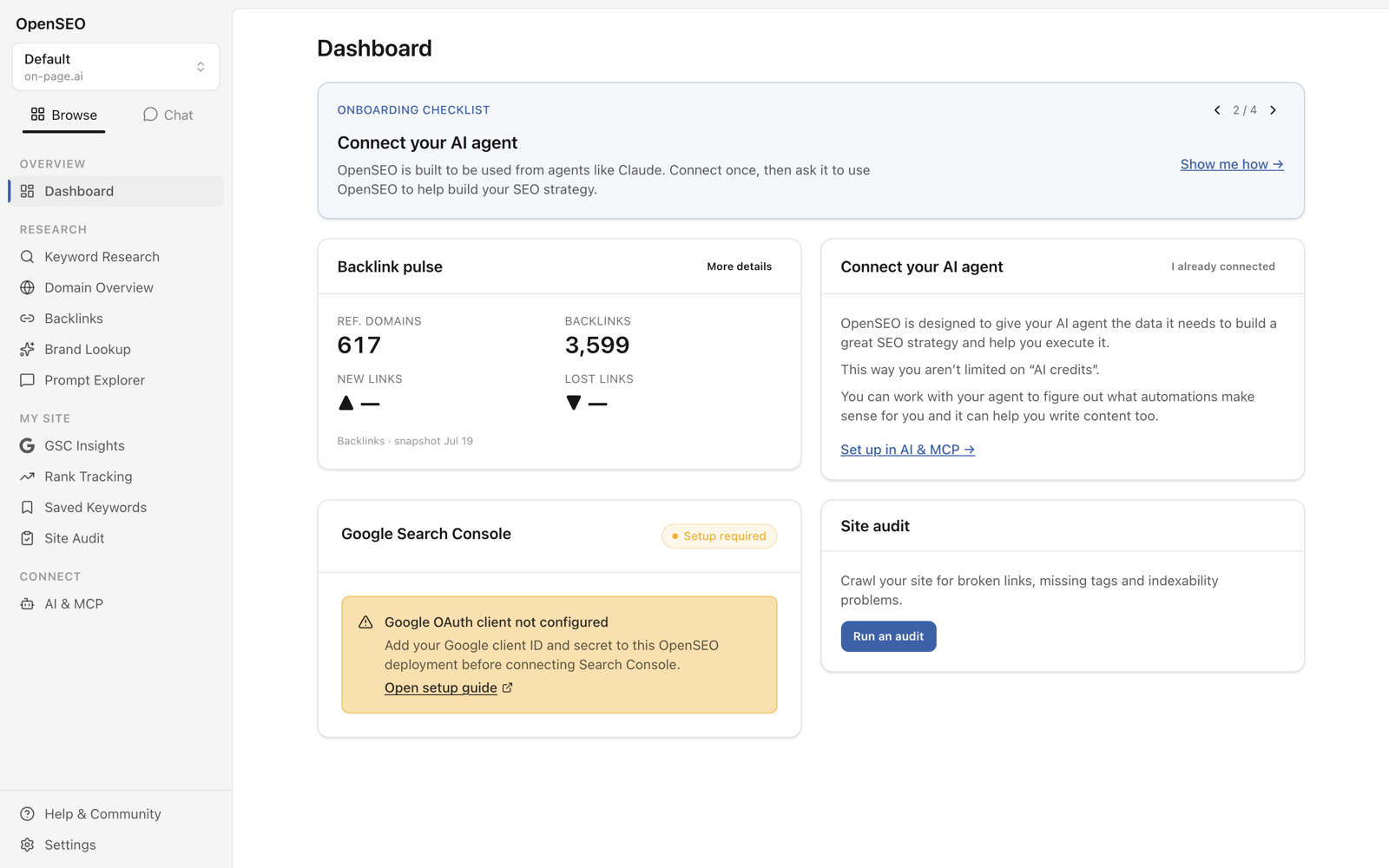
The dashboard drops you into an onboarding checklist: set your domain, connect your agent, run an audit. No feature tour, no upsell modals.
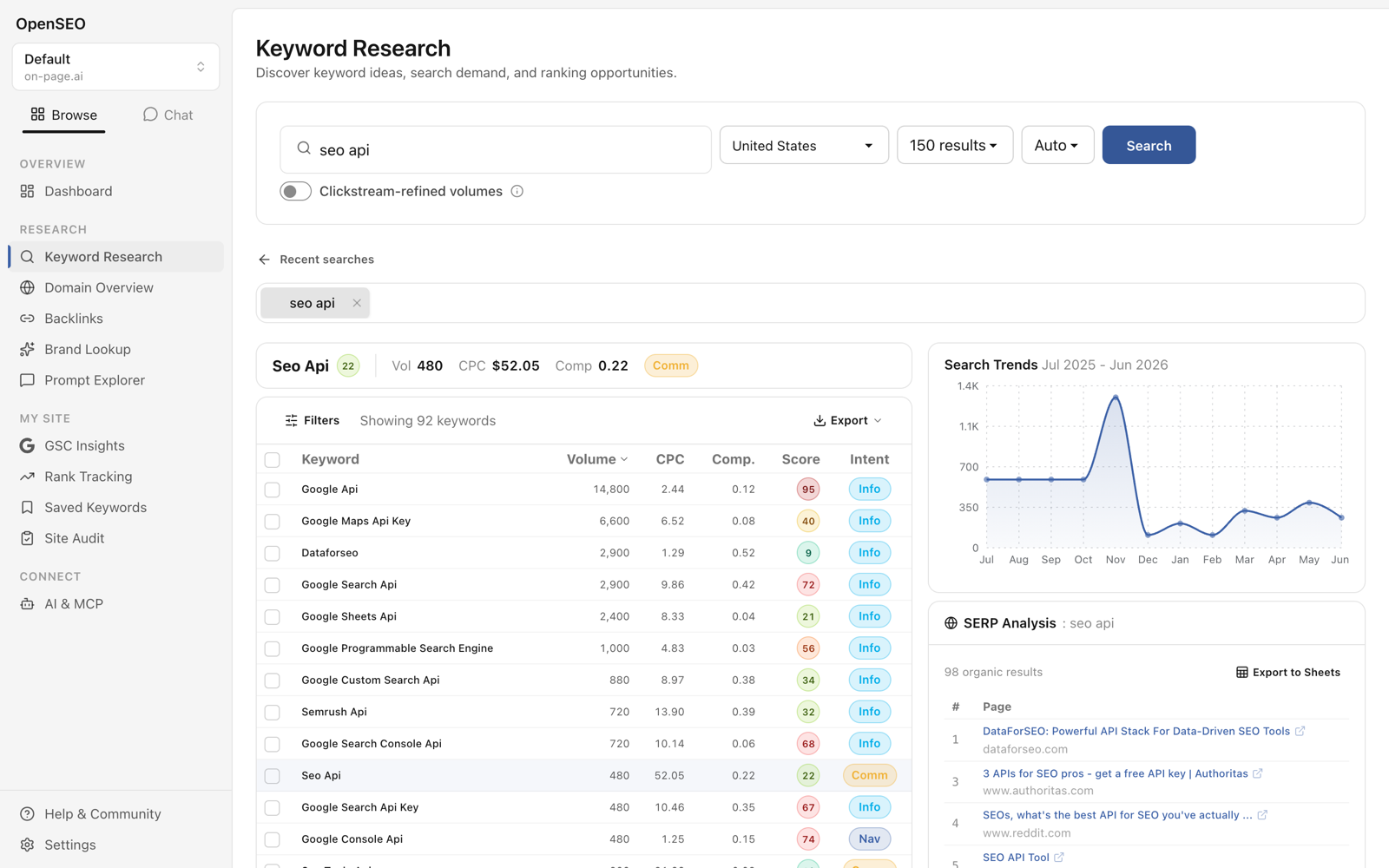
Keyword research is the core workflow and it works like you would hope. I searched "seo api": search volume 480, CPC $52.05, 92 related keyword ideas with volume, CPC, competition, a difficulty score and intent classification per keyword, twelve months of trend data, and a SERP analysis panel listing the 98 organic results with their metrics. That is genuine Ahrefs-class working data, and the query cost cents.
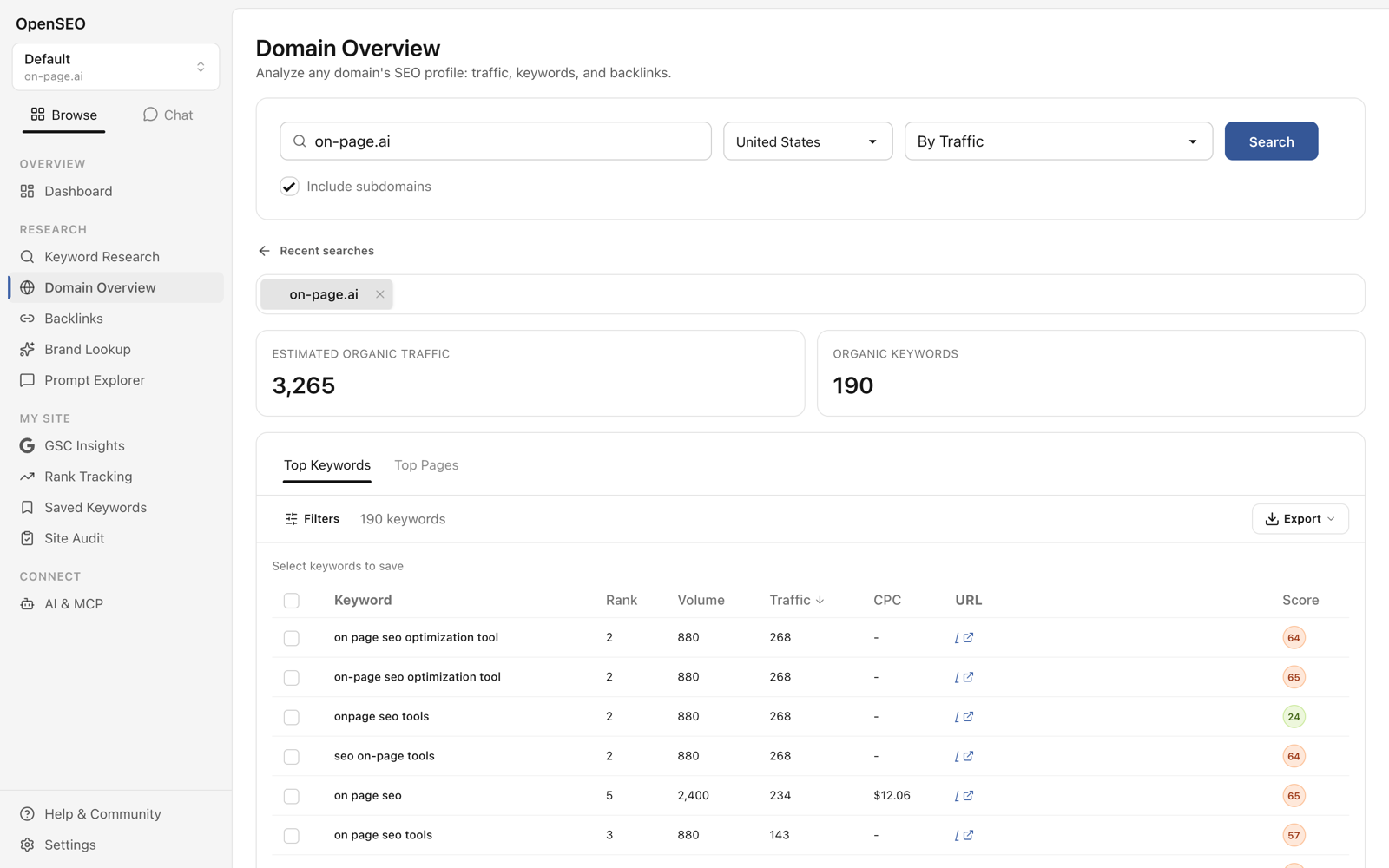
Domain overview, backlinks, and rank tracking follow the same pattern: focused single-purpose pages backed by DataForSEO endpoints, with CSV and Google Sheets export. Rank tracking supports desktop and mobile, city-level local targeting, and scheduled checks. The site audit is an in-house crawler that checks the technical layer: broken links, missing and duplicate titles and descriptions, canonicals, redirect chains, indexability, structured data, with Lighthouse performance data per page.
The honest limitation: the audit is technical SEO only. It counts words on a page, but it does not evaluate content quality, semantic coverage, or how your page compares to what currently ranks. That is a deliberate scope decision on their part. It is also the layer where I should disclose my bias: content optimization is exactly what we build at on-page.ai, with an API and MCP for agents at api.on-page.ai. In practice the two pair well: OpenSEO covers keywords, links, rankings, and technical health, and a content optimization tool covers what the words on the page need to say.
Keyword difficulty and intent come from DataForSEO's Labs endpoints, so coverage varies by market. I would call the data solid for the major English markets I tested and unremarkable elsewhere, which is a DataForSEO property rather than an OpenSEO one.
One honest caveat on data depth. Ahrefs and Semrush operate their own massive crawling infrastructure, and it shows most in two places: backlink data and traffic estimates. DataForSEO's link index is real and useful, but it is smaller, and if your work leans hard on link intelligence (deep link audits, competitor link gap analysis) or on traffic estimation accuracy, the big suites deliver measurably richer data there. Know what you are trading. Nothing at this price competes with OpenSEO's numbers, but the trade is depth for cost, and for link-heavy work Ahrefs remains the standard.
The MCP angle is the real differentiator
Every feature in OpenSEO is also exposed as tools on an MCP server, so Claude Code, Codex, and other agents can run keyword research, pull backlink profiles, check rankings, and launch audits directly. There are prebuilt agent skills in the repo for guided workflows like keyword clustering and competitor analysis.
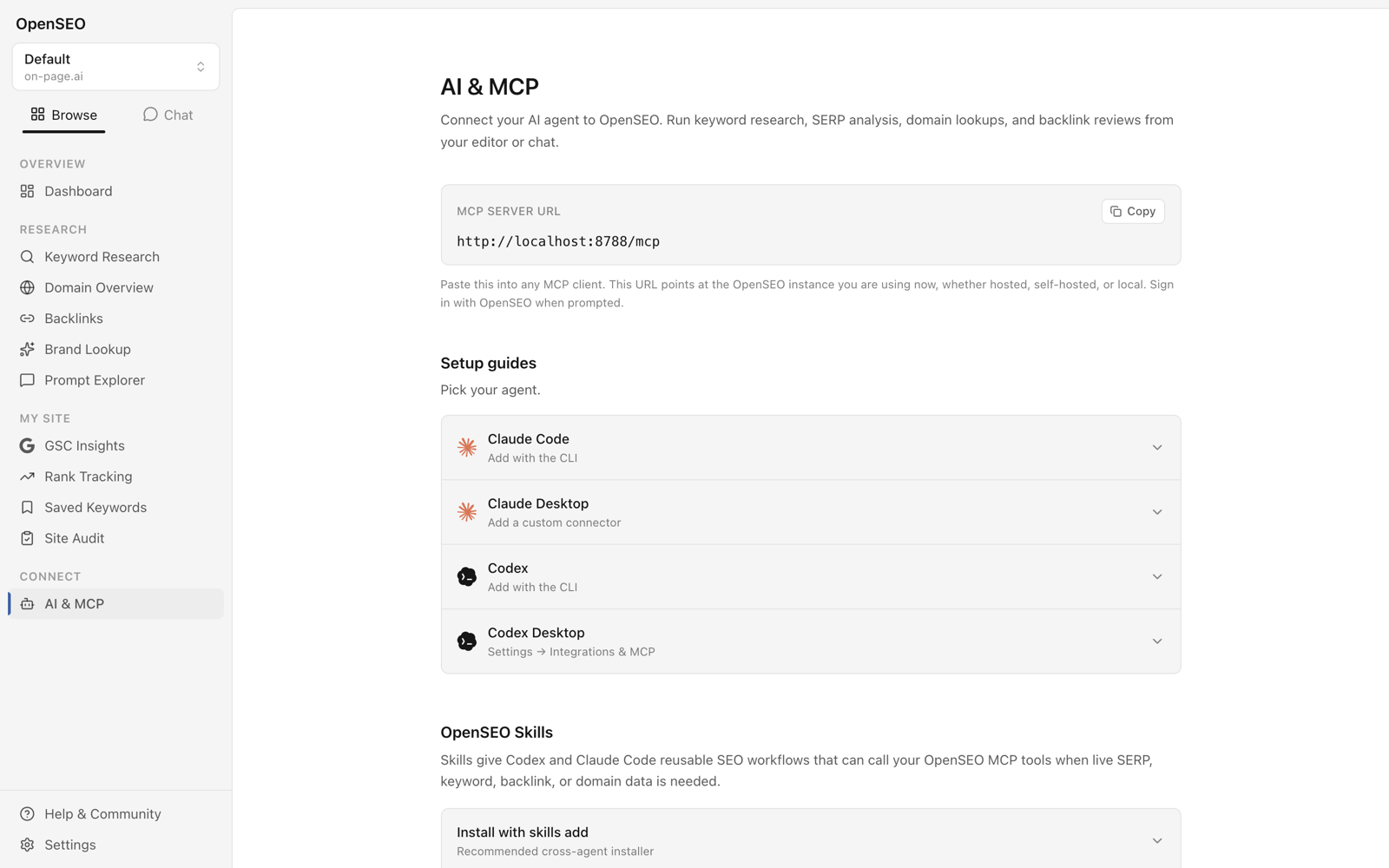
This inverts the usual SEO tool relationship. Instead of you reading dashboards, your agent queries the data mid-task: "find keywords we can rank for, check what currently ranks, draft a brief." The incumbents are bolting AI chat onto their dashboards; OpenSEO went the other direction and made the whole product agent-readable. For anyone already working with coding agents, this alone justifies the install.
What it actually costs
Self-hosted, OpenSEO is free and you pay DataForSEO usage directly. Their minimum top-up is low, and in my testing a keyword research query ran a few cents. A realistic solo-site month of keyword research, a weekly rank check on a few dozen keywords, and an occasional audit lands in the range of a few dollars to low tens of dollars, depending mostly on rank-check frequency.
The hosted version at app.openseo.so is $10 a month including $10 of usage, with per-action pricing after that (keyword searches around five cents, backlink checks around eight). The hosted service marks up DataForSEO costs by 28 percent, and I only know that number because it is published in their open codebase. Open source makes that level of pricing transparency possible, and it builds real trust.
For light and moderate use, usage-based pricing lands far below the $129 to $139 entry plans of the established suites. The suites win that math back at scale: if you are tracking thousands of keywords daily across many clients, flat-rate bundled economics and their mature tooling are worth every dollar. That crossover point is the honest way to decide, and plenty of readers will land on the Ahrefs side of it.
Contributing to it
Because the code is open, when I hit a small timezone display bug in rank tracking, I read the source, wrote a fix with tests, and sent a pull request the same day. The repo has clear contribution guidelines, a CI suite that runs formatting, type checks and linting in one command, and a track record of merging outside contributions, including whole features. The project also runs a Discord where the maintainer answers directly.
That is the practical meaning of open source here: the tool bends to your needs, and problems are fixable by anyone motivated, on their own schedule.
Update: I liked it enough to fork it
The gap I flagged above is the one I care about most, because content optimization is what we build at On-Page.ai. Open source means you do not have to wait on anyone else's roadmap to close a gap like that, so I forked OpenSEO and built our content optimization into it.
The fork lives at github.com/lanpublications/open-seo. It is everything upstream OpenSEO does, plus a Content Optimization page under Research. Enter a keyword and a URL, pick one of 27 Google markets, and the scan compares your page against the pages ranking right now:
- An optimization score with a plain-language summary
- Entity coverage: which concepts the ranking pages establish that your page is missing, sorted by importance, with a click-to-copy worklist
- Structure benchmarks: your word count, headings, images, and entities next to the page-1 average
- Competitor term coverage: every term the top pages use, with your count vs theirs
- Your page's Google category vs the categories of the pages that rank
- Topical authority questions, a suggested title, and internal link opportunities
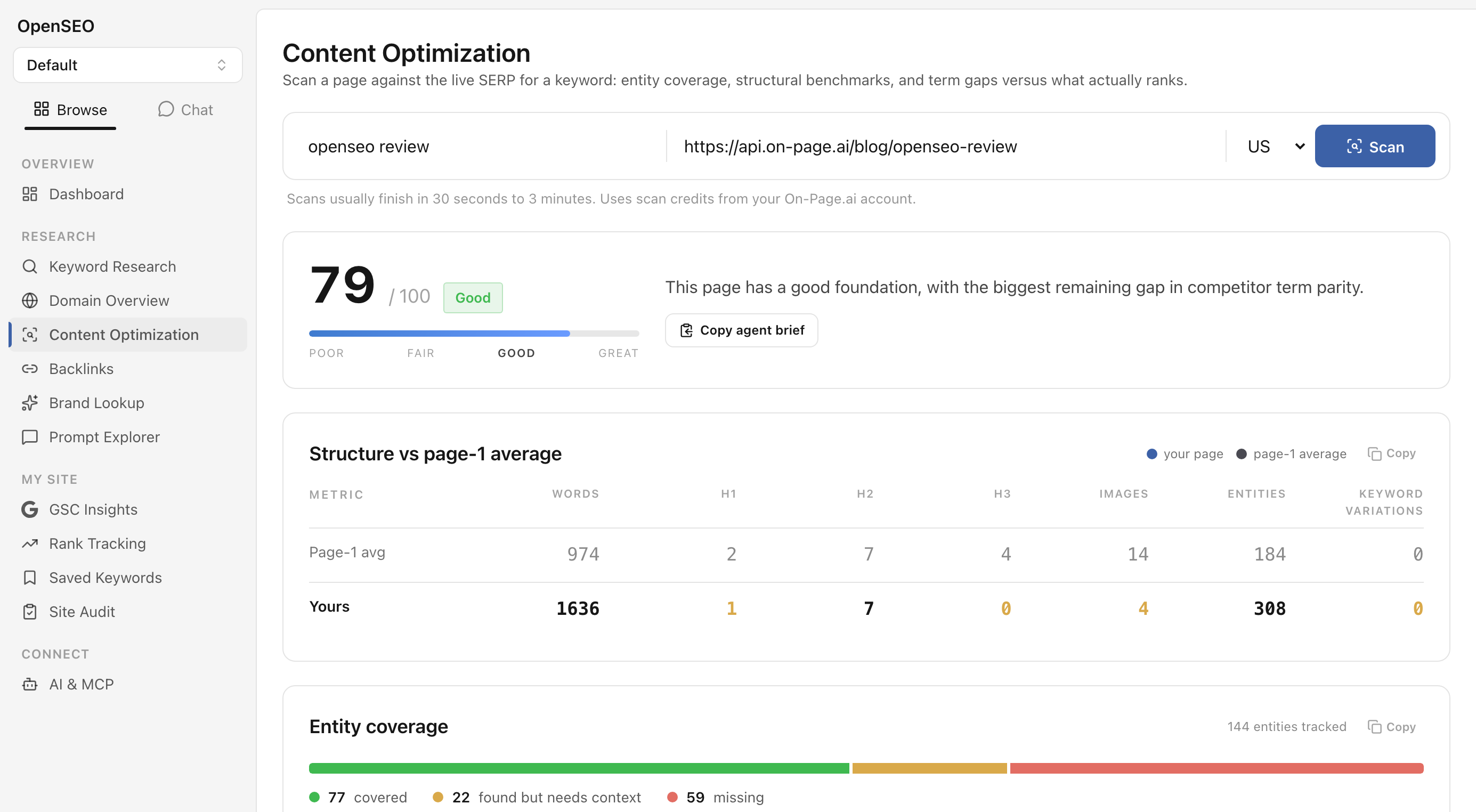
Since the MCP server is my favorite part of OpenSEO, the module plugs into it too. It registers two MCP tools, run_content_scan and get_content_scan, so an agent connected to your install, or OpenSEO's built-in chat, can run a scan mid-task and read the results back.
Using it with api.on-page.ai
The module is bring-your-own-account, the same model OpenSEO uses for DataForSEO. Open Content Optimization, click Connect your On-Page.ai account, sign up or sign in on api.on-page.ai, and approve the connection. The key is delivered and stored automatically, with no env editing and no restart. If you prefer configuration as code, set ONPAGE_API_KEY in your .env instead.
Scans run on your api.on-page.ai account, and every report is saved to your OpenSEO database, so reopening a past scan does not rerun it.
Installing the fork
git clone https://github.com/lanpublications/open-seo.git
cd open-seo
cp .env.example .env   # add your DataForSEO key
docker build -f Dockerfile.selfhost -t open-seo:local .
OPEN_SEO_IMAGE=open-seo:local docker compose up -d
Then open http://localhost:3001 and find Content Optimization under Research. One detail matters: build the image locally as shown. A plain docker compose up -d pulls the upstream prebuilt image, which does not include the module. The fork's README covers upgrades and other setups.
Verdict
OpenSEO will not replace an enterprise Semrush seat, and it does not try to. What it delivers is professional-grade SEO data with focused workflows at usage-based cost, self-hostable, with the best agent integration story in the category right now.
Recommended for: solo builders and small teams priced out of the incumbents, technical SEOs who want their data agent-accessible, and anyone who prefers auditable open source tooling.
Look elsewhere if: you need massive-scale daily rank tracking, agency client management, or the deepest backlink and traffic data (Ahrefs' index remains the benchmark there). And for content-quality analysis, the layer OpenSEO deliberately skips, that is what we build at on-page.ai. If you want that layer inside OpenSEO itself, the fork adds it.
It is rare that a five-month-old open source project feels this complete. OpenSEO is the most credible open source SEO tool I have used, and given the release pace, I expect the gaps to keep closing. Star the repo, try the self-host path, and see how far $5 of DataForSEO credits takes you.
Eric Lancheres has been doing SEO research since 2011 and builds SEO analysis tools at on-page.ai.