Search-intent preflight
Should You Let AI Publish Webpages Without Search Context?
AI can generate a polished page faster than a team can review it. That changes the publishing problem. The gate is no longer "does this read well?" It is "does this page match the live SERP we are trying to compete in?"
Example
Shopify thermal label printer
Gate
Pass / review / fail
Output
Smallest useful edits
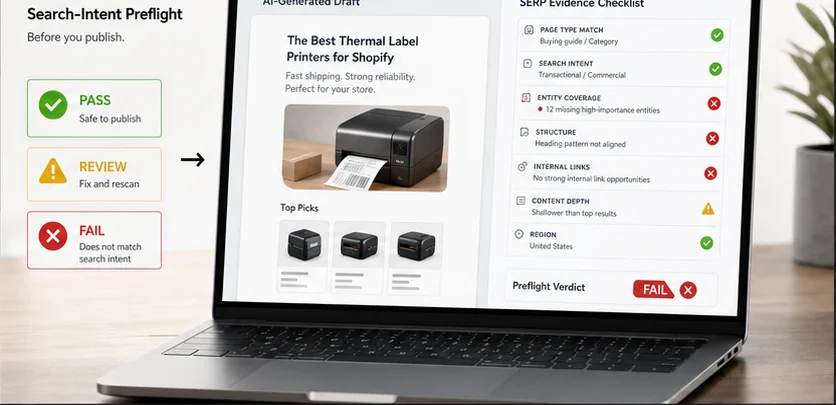
I do not let AI publish SEO pages directly anymore. Not because AI cannot write. It can. The problem is that a fluent draft can be wrong in ways that are invisible if you only read the page.
The draft can have a clean H1, sensible sections, nice grammar, and still miss what the search result actually expects. It can target the wrong page type. It can skip the entities buyers use to compare options. It can forget internal links. It can be locally wrong because the US SERP and UK SERP are not the same.
That is not a writing problem. It is a deployment problem. If an agent can generate a page, it should also be able to run a search-intent preflight before the page ships.
The simplest example: a page that reads well but should not ship
Use a mundane ecommerce example. The target keyword is shopify thermal label printer. The AI draft looks like a reasonable page for a store that sells shipping printers. A human skimming the page might approve it.
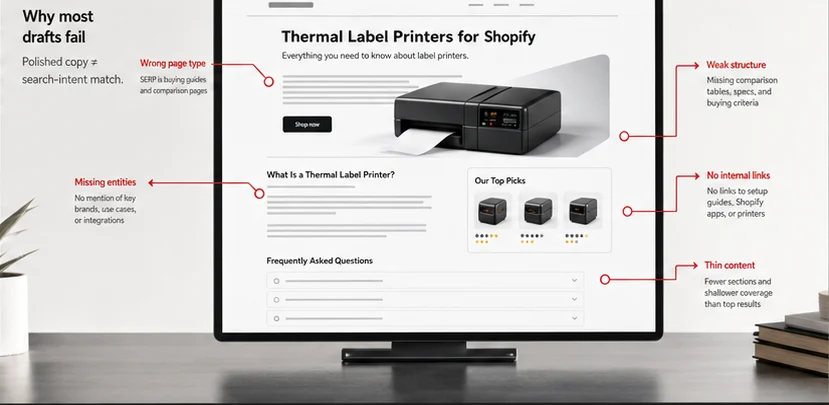
Target keyword: shopify thermal label printer
Region: US
Draft page: /best-thermal-label-printer-for-shopify

The AI draft looked plausible:
- H1: Best Thermal Label Printers for Shopify Stores
- Sections: Benefits, Features, Setup, FAQ
- Tone: Helpful, clean, commercial
- Word count: enough to feel complete

The preflight still returned REVIEW:
- SERP page type looked closer to comparison / buying guide
- Missing terms: 4x6 labels, direct thermal, Zebra, Rollo, DYMO
- Weak buyer questions: setup, label size, barcode support, OS support
- No internal links from shipping or ecommerce operations pages
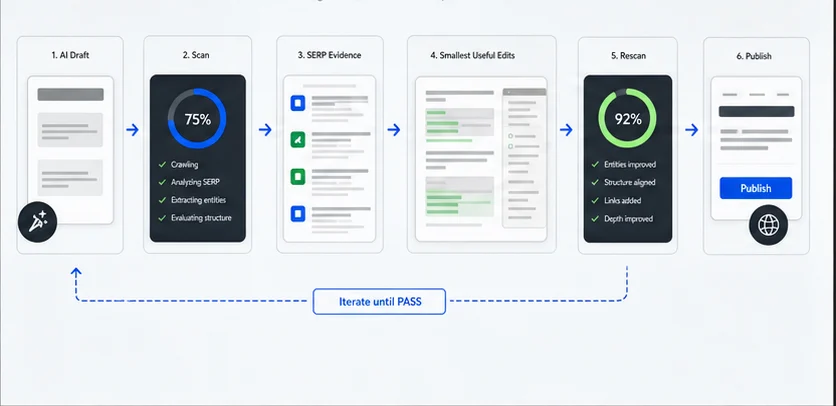
- No rescan verdict after edits
Nothing there says the page is hopeless. It says the page is not ready. The useful output is not a bigger rewrite. The useful output is a narrow decision: review before publish, with evidence.
{
  "verdict": "REVIEW",
  "reason": "The page targets the topic, but not the US SERP pattern.",
  "fix_before_publish": [
    "Add a comparison section for Rollo, DYMO, and Zebra.",
    "Add Shopify Shipping setup and 4x6 direct thermal language.",
    "Add internal links from shipping and fulfillment pages.",
    "Rescan before publication."
  ]
}
What the preflight is checking
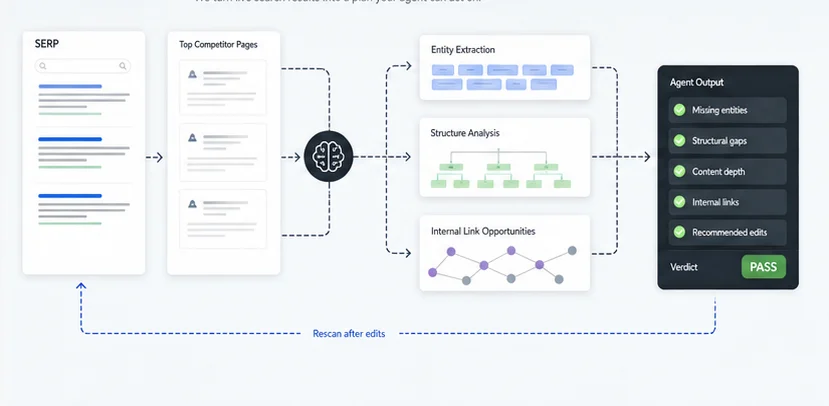
A search-intent preflight is not a generic SEO score. It is a pre-publication gate. The agent compares the draft against the live competitive pattern for one keyword, one URL, and one region.
Check
Page type
Weak draft
The page was a polished generic product page.
Preflight question
Are top results mostly category pages, comparison pages, tools, docs, or buying guides?
Check
Entities
Weak draft
It used the keyword but skipped recurring buyer terms.
Preflight question
Which high-importance entities appear across the SERP cohort but not on this page?
Check
Structure
Weak draft
The H2s sounded organized but did not match how buyers compare options.
Preflight question
Which sections do competitors consistently include that this page does not address?
Check
Internal links
Weak draft
The page had no support from related pages on the same site.
Preflight question
Which existing pages should link here, with what anchor text, and why?
Check
Region
Weak draft
It assumed the US SERP and vocabulary were universal.
Preflight question
Does the selected country change terminology, competitors, examples, or page type?
Check
Rescan
Weak draft
The agent edited once and declared the page ready.
Preflight question
Did the page improve after edits, and is the final verdict pass, review, or fail?
The checklist I want agents to run
This is the minimum checklist. It is intentionally boring. Boring is good here. A preflight that sounds clever but cannot decide whether the page should ship is theater.
Step
Intent
Question
What job does the searcher want this page to do?
Output
One sentence describing the dominant intent.
Step
Page type
Question
What kind of page is Google surfacing for the keyword?
Output
Article, category, product, comparison, tool, docs, local page, or mixed.
Step
Entity coverage
Question
Which important recurring entities are missing or shallow?
Output
Prioritized list with natural edit locations.
Step
Structure
Question
Which sections, headings, and decision points are underrepresented?
Output
Section-level edit plan, not a full rewrite.
Step
Internal links
Question
Which same-site pages should support this URL?
Output
Source URL, target URL, suggested anchor, reason.
Step
Local SERP fit
Question
Does region change the competitive pattern?
Output
Country-specific notes or confirmation of no material difference.
Step
Edit safety
Question
Can the agent fix the problem without flattening the page?
Output
Smallest useful edits first.
Step
Decision
Question
Should this ship now?
Output
PASS, REVIEW, or FAIL with evidence.
The last row matters. Agents are often good at suggesting more work and bad at saying no. A preflight should be allowed to fail a page. If the SERP wants a comparison page and the agent wrote a generic landing page, the correct move may be to re-brief the page rather than polish it.
The agent contract
The prompt should not say, "make this page better." That invites a generic rewrite. The prompt should say, "decide whether this page can ship." The agent must gather evidence first.
You are running a search-intent preflight before publication.

Target URL: https://example.com/best-thermal-label-printer-for-shopify
Target keyword: shopify thermal label printer
Region: US

Use the On-page.ai MCP server.

1. Run scan_page for the URL, keyword, and region.
2. Use wait_for_job to fetch the result.
3. Identify the dominant page type in the live SERP.
4. Identify missing high-importance entities and related terms.
5. Identify structural gaps in headings and sections.
6. Identify internal-link opportunities.
7. Recommend the smallest useful edits.
8. Return PASS, REVIEW, or FAIL.

Do not rewrite the whole page unless the page type is wrong.
The phrase "smallest useful edits" is doing a lot of work. It prevents the agent from flattening a page into generic SEO copy just because it found missing terms. A good preflight should preserve what is already useful and fix only what the evidence justifies.
What this is not
It is not a promise that a page will rank. It is not a traffic forecast. It is not a way to avoid editorial judgment. It is a quality gate that catches search-context mistakes before they become published inventory.
The strongest use case is not "publish 1,000 AI pages." It is "reject or repair weak pages while they are still drafts." That is more useful for agencies, SaaS teams, ecommerce operators, and AI site builders than another writing prompt.
Build it yourself
You can build this workflow without On-page.ai. The requirements are straightforward. They are just annoying to maintain.
- Fetch the current SERP for a specific keyword and country.
- Classify the page types in the ranking cohort.
- Extract recurring entities and related terms from competitors.
- Compare the target page against that cohort.
- Benchmark structure, headings, and topical coverage.
- Find internal-link opportunities from the same site.
- Feed the evidence to the editing agent.
- Rescan after edits and record the verdict.
Disclosure: this is where On-page.ai fits. We expose the evidence layer through an API and MCP connector, so an agent in Codex, Cursor, Claude, ChatGPT, VS Code, Windsurf, or Cline can run the scan directly, wait for the result, and turn the report into edits, briefs, internal-link plans, or pass/review/fail recommendations.
The rule I would put in the publishing workflow
Agents can draft. Agents can revise. Agents can propose internal links. But an AI-generated SEO page does not ship until it has a search-intent preflight verdict attached to it.
The important mental model is simple:
If that becomes a normal content workflow, the question changes from "can AI write this page?" to "can this page survive contact with the SERP?"